 SONG
SONGLyrical DNA
Light Is Good
A song about the light reactions of photosynthesis. The lyrics run from photosystem II splitting water and releasing oxygen, along the electron transport chain in the thylakoid membrane to photosystem I and NADPH, through the proton gradient that drives ATP synthase, and on to the ATP and NADPH that power the Calvin cycle in the stroma. Select any highlighted line to see the biology behind it.
Trouble playing? Watch on YouTube
Interactive lyrics
Lines with a dotted underline and a + marker have an explanation. Select one and the science appears beside the lyrics. Everything else is ordinary lyric text.
Intro
Morning spills gold on the edge of the blue,
I open every window, let the good light through.
Verse 1
Pre-Chorus
Every ray becomes a road,
Every road can carry hope.
When the whole sky pours in,
I know where the good begins.
Chorus
Life is good, life is good in the light,
Life is good, let the bright current run,
Make a little power from the promise of the sun.
Life is good, life is good in the light,
I got tomorrow growing on the inside.
Verse 2
Pre-Chorus
Every ray becomes a road,
Every road can carry hope.
When the whole sky pours in,
I know where the good begins.
Chorus
Life is good, life is good in the light,
Turn the day into a spark I can carry through the night.
Life is good, let the bright current run,
Make a little power from the promise of the sun.
ATP, NADPH,
Pack the light away for what comes next.
Life is good, life is good in the light,
I got tomorrow growing on the inside.
Bridge
Protons cross the membrane,
Power turns the key.
And everything feels fine.
Final Chorus
Life is good, life is good in the light,
Turn the day into a spark I can carry through the night.
Life is good, hear the whole green world hum,
Every, every living process needs the energy to come.
ATP, NADPH,
Feed the cycle, build what life will need.
Life is good, life is good in the light,
I got tomorrow growing on the inside.
Outro
Let it in, let it run,
Let it in, let it run,
Life is good beneath the sun.
Concepts covered
Photosystem II and water oxidationThe second station is photosystem II, and it acts first. The photosystems are numbered in the order they were discovered, not the order they work. Chlorophyll in photosystem II absorbs light and boosts electrons to a higher energy level, and those electrons leave for the transport chain. Water then splits to supply electrons that replace the ones lost, which is the start the lyric sings about. Oxygen is what remains of the split water, and it is released.
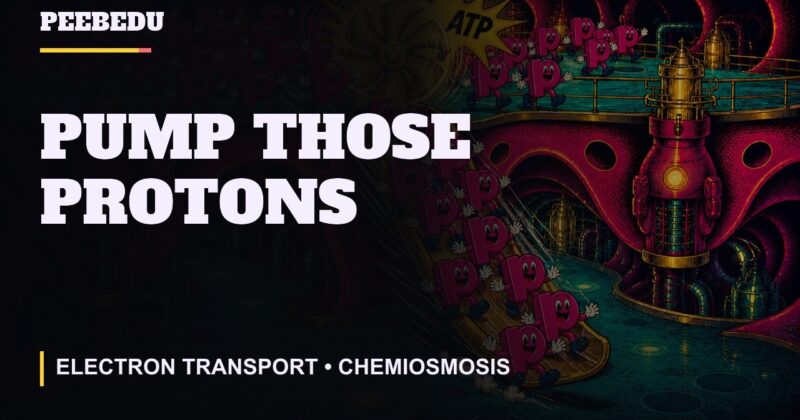
Photosynthetic electron transportThe stepping-stones are the electron transport chain in the thylakoid membrane, which links photosystem II to photosystem I. At each step the electrons give up a little more of the energy light gave them, and that energy moves protons from the stroma into the space inside the thylakoid. That interior is the other side of shore. The result is an electrochemical gradient, with protons concentrated inside the thylakoid and scarce in the stroma.
ATP synthase and photophosphorylationThe tiny turbine is ATP synthase in the thylakoid membrane. Protons flow back through it from the thylakoid space into the stroma, and that flow drives ATP formation from ADP and inorganic phosphate. This is the same chemiosmosis mitochondria use, called photophosphorylation here. What differs is placement: ATP is released on the stroma side, where the Calvin cycle will spend it. Like a sunrise, the gradient is built and kept up only while light keeps electrons moving.
Photosystem I re-energizes electronsThe first station is photosystem I, the second stop in the electron path. Tired electrons are the ones arriving down the transport chain after spending energy on the proton gradient; electrons do not literally tire, they just sit at a lower energy level. The fire in their eyes is the boost chlorophyll gives them when photosystem I absorbs light. Electrons that photosystem I sends onward are replaced by these arrivals from the chain, which is what connects the two photosystems.
Reduction of NADP+NADP+ is the final electron acceptor of the light reactions, the last hand in the line. At photosystem I, electrons are transferred to NADP+, and with a proton added it is reduced to NADPH. The plus sign in NADP+ goes away when it is reduced, so hold the charge does not mean holding that plus sign; it means holding energy in those high-energy electrons. In the mitochondrial chain the last acceptor is oxygen; here the electrons stay in NADPH until the Calvin cycle uses them.
ATP and NADPH power the Calvin cycleThe two bright currencies are ATP and NADPH, made at the thylakoid membranes and used in the stroma, where the Calvin cycle runs. Carbon getting bound means carbon from carbon dioxide being fixed and built, piece by piece, into carbohydrates, work that ATP and NADPH power. The round fits the name, since a cycle turns again and again while its supply lasts. It also releases ADP, phosphate and NADP+, which the light reactions reuse, so each half keeps the other supplied.
Two photosystems in lineThe two photosystems sit in line in the thylakoid membrane, connected by the electron transport chain. Light lifts them twice: electrons are boosted at photosystem II, give up part of that energy along the chain to build the proton gradient, and are boosted again at photosystem I before they reduce NADP+. Energy becomes chemistry sums up the result: light energy, which the plant cannot hold as light, ends up as chemical energy in ATP and NADPH.
The chloroplast and its fluidsThe green-lit room fits the chloroplast, colored by the chlorophyll in its thylakoid membranes. The little ocean is harder to pin down, because a chloroplast holds more than one fluid. The two that matter most here are the stroma, inside the inner membrane but outside the thylakoids, and the space inside the thylakoids. The lyric does not say which it means, and the song needs both: the light reactions run in the thylakoid membranes, and the Calvin cycle runs in the stroma.
What photosynthesis uses and makesPhotosynthesis uses light energy, carbon dioxide and water to make carbohydrates and release oxygen. The photon is the light, but the bloom is not made of light. Light supplies only the energy; the matter of a flower or leaf comes mainly from carbon dioxide taken in from the air, so most of a plant's dry mass is built from a gas. Catching the photon is the job of chlorophyll, and turning its energy into sugar takes both parts of photosynthesis, the light reactions and the Calvin cycle.
ATP and NADPH, the light reaction productsATP and NADPH are the two products of the light reactions, and they hold energy in different forms. ATP delivers energy directly to reactions that need it. NADPH carries high-energy electrons, the reducing power needed to turn carbon dioxide into sugar. Packing the light away means converting light energy into chemical energy in these molecules. Neither is built up as a long-term store; the plant's lasting store is sugar, made in what comes next, the Calvin cycle.
Stored sugar powers the nightThe light reactions run only while there is light, but the sugar photosynthesis makes lasts. Photosynthesizing leaf cells have both organelles: chloroplasts that capture light energy by day, and mitochondria that break sugar down through cellular respiration by day and by night. Respiration releases that stored energy to make ATP whenever the cell needs it. The spark is a metaphor for energy held in sugar, which a plant can keep for hours or move to other tissues after the sun goes down.
Sugar as fuel and building materialSugar is both fuel and building material. Most roots grow in dark soil and cannot photosynthesize, and fruit makes little sugar of its own, so both depend on sugar sent from photosynthesizing leaves. Leaves belong in the list because they spend their own sugar too. Wherever it goes, its carbon is rebuilt into starch and cellulose, and, with nitrogen, phosphorus and other elements added, into the proteins, lipids and nucleic acids a plant is made of.
Oxygen comes from waterThese are the electrons photosystem II takes from water, as in Verse 1. Set free means released as a byproduct, and the oxygen photosynthesis releases comes from the water that is split, not from carbon dioxide. Photosynthesis first evolved in prokaryotes; evidence shows cyanobacterial photosynthesis produced the oxygenated atmosphere, and those pathways became the foundation of photosynthesis in plants and algae. Nearly every breath of oxygen traces back to split water.