 SONG
SONGLyrical DNA
Pump Those Protons
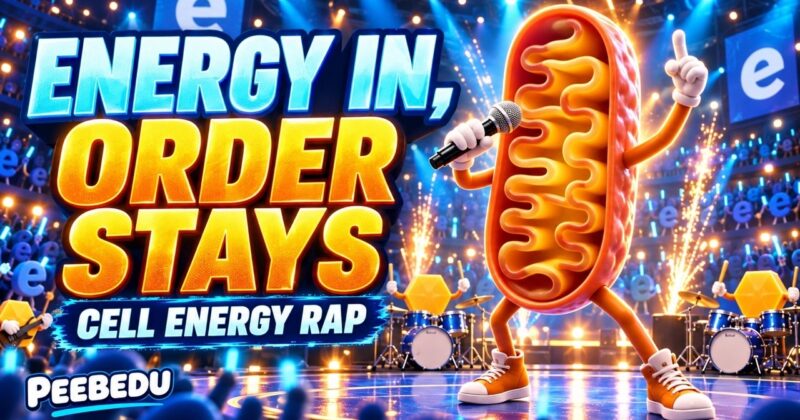
Follow electrons from NADH and FADH2 through the mitochondrial electron transport chain as their energy builds a proton gradient, drives ATP synthase, and ends with oxygen accepting electrons to form water.
Trouble playing? Watch on YouTube
Interactive lyrics
Lines with a dotted underline and a + marker have an explanation. Select one and the science appears beside the lyrics. Everything else is ordinary lyric text.
Intro: Bright High Male Hype Shouts
Verse 1: Fast Playful Hype Rap
Build: Shouted
Something is coming!
Pre-Drop: Cat Caterwauls and Gnarls
MRAAAAAOOOW!
GNARRR-R-R-RAOW!
HISSSSSS-GRRRAAAH!
Drop / Chorus
Verse 2: Fast Playful Hype Rap
Build: Shouted
Pre-Drop: Cat Caterwauls and Gnarls
YAAAAAOOOW-OW-OW!
GNARL-GNARL-GRRRRAOW!
MREOW! MREOW! MREOW!
Drop / Chorus
Bridge: Half-Time Goofy Lab Announcer
Spoken
Final Build
Pre-Drop: Maximum Cat Caterwauls and Gnarls
MRRRAAAAAAAOOOOW!
GNARRRRR-HISSSSS-GRRRRAAAH!
RAOW! RAOW! RAOW! RAOW!
Final Drop / Chorus
Outro: Cat Whisper
Mew.
Concepts covered
Where the mitochondrial ETC operatesThe electron transport chain sits in the inner mitochondrial membrane, which is where the loaded carriers deliver their electrons. A mitochondrion has two membranes, the outer one smooth and the inner one highly convoluted. The double membrane provides separate compartments for different reactions of aerobic respiration, and the folding of the inner membrane increases surface area, which allows more ATP to be synthesized.
Electron carriers deliver electronsNADH and FADH2 are the coenzymes that carry electrons, and this is the moment they hand them off. The delivery point is the electron transport chain in the inner mitochondrial membrane. Once the transfer happens the carriers are spent and go back for another load, which is why a cell needs them returned empty as much as it needs them arriving full.
Where NADH and FADH2 come fromGlycolysis releases the energy in glucose to form ATP, NADH from NAD+, and pyruvate. Pyruvate is then transported from the cytosol into the mitochondrion, where oxidation during the Krebs cycle in the matrix reduces NAD+ to NADH and FAD to FADH2 and releases carbon dioxide. Both pathways are harvesting electrons out of fuel, and the loaded carriers are the product that matters downstream.
NADH and FADH2 transfer electronsDonating is an oxidation. NADH and FADH2 give up the electrons they carry and are converted back to NAD+ and FAD, free to be loaded again upstream, while the electrons pass on to molecules of the chain itself. The front gate is a metaphor. The electrons are transferred to the chain, but there is no single labeled entrance that every carrier has to pass through.
Electron transport uses redox reactionsEach handoff is an oxidation-reduction reaction. One molecule loses the electrons and is oxidized while the next gains them and is reduced, in a series that runs along the membrane and establishes an electrochemical gradient across it. That series is what the term electron transport chain names. What matters is the order of the transfers, not the names of the individual carriers.
Electron transfer establishes a proton gradientThe transfer of electrons through the chain is accompanied by the movement of protons out of the matrix, leaving a region of high proton concentration outside the inner membrane and a region of low concentration inside it. Protons are being moved toward the side where they are already crowded, so this is active transport, and metabolic energy is required to establish such a gradient and to maintain it.
Building stored potential energyNo new energy appears at this step. Energy released by the electron transfers is transferred rather than created, into the electrochemical gradient of protons across the inner mitochondrial membrane, where it is stored until something draws on it. Climbing is a metaphor for that rising store of potential energy, not for anything being lifted against gravity.
The proton electrochemical gradientElectrochemical means two differences at once. Protons are more concentrated in the intermembrane space, which is why the pH inside the matrix is higher than the pH out there, and because every proton carries a positive charge, the two sides differ in charge as well. Both differences store energy. Up and stack are spatial metaphors for moving protons out of the matrix, not for piling them into layers.
Chemiosmosis drives ATP formationMaking ATP this way has a name: oxidative phosphorylation in aerobic cellular respiration. Chloroplasts run the same kind of chemiosmotic flow through an ATP synthase of their own, where it is called photophosphorylation instead, so one mechanism serves both energy pathways. Spin that door is a metaphor for the enzyme, and LARGE means more ATP molecules, never a bigger molecule.
High proton concentration outside the matrixProtons are charged, and charged ions do not cross the lipid interior of a membrane on their own; moving them takes a transport or channel protein. That is why protons accumulate in the intermembrane space instead of leaking back wherever they please. ATP synthase provides the controlled route back, which is how the return flow gets coupled to ATP synthesis.
Proton-motive forceProton motive force is the song's name for the electrochemical gradient of protons established across the inner mitochondrial membrane. The phrase points at stored potential rather than a push. Nothing is actively shoving the protons, and the store does work only when a pathway opens. Unruly personifies that tendency to return.
ATP synthase couples proton flow to ATP productionThe flow of protons back through membrane-bound ATP synthase, down their gradient and into the matrix, drives the formation of ATP from ADP and inorganic phosphate. Coupling the synthesis to that flow is what chemiosmosis means. Energy is transferred out of the gradient and into the new bond; the protons themselves never become ATP.
Stepwise electron transfers power proton pumpingEnergy related pathways run in sequence so that energy is transferred in a controlled way, the product of one reaction serving as the reactant for the next. Processes that release energy can be coupled to processes that require it, which is the link between electron transfer and proton pumping. The electric stampede is a metaphor, and ATP is also formed in glycolysis and in the Krebs cycle, so this pathway is not the cell's only source.
Protons return through ATP synthaseThe gate is a metaphor for the enzyme's proton pathway, a fixed route through a protein rather than a door that opens and shuts. Nothing has to signal it open. As long as protons stay more concentrated on one side they move back through, and the chain goes on pumping while they do. Ready is less a state the membrane enters than a condition the gradient keeps up.
Oxygen is the terminal electron acceptorElectrons delivered by NADH and FADH2 pass to a series of electron acceptors as they move toward the terminal acceptor, oxygen. Oxygen does not power the chain; it clears the end of it, and with nothing to accept the electrons the series cannot keep passing them along. Glycolysis can still proceed if fermentation regenerates the carrier it needs. Aerobic prokaryotes use oxygen this way, while anaerobic prokaryotes use other molecules.
Oxygen reduction forms waterAccepting electrons is a reduction, and oxygen is what gets reduced at the end of the chain. After it takes those electrons it picks up protons from the matrix, and the result is water. That is also why an aerobic cell needs a steady oxygen supply. With nothing to accept electrons at the end, the chain backs up and the pumping stops.
Water forms as molecules, not a puddleWater is a small polar uncharged molecule, one of the few that crosses a phospholipid membrane on its own, though only in small amounts. A puddle is a bulk scale shape. At molecular scale there is nothing to stand in and nothing to walk around, and the few molecules formed at the end of the chain simply join the water already filling the matrix.
Electron transport and chemiosmosis recapCarrier delivery supplies the transfers, the transfers move protons, and the proton flow is what ATP synthase draws on. That order is the argument the whole song is making, and it is why these callouts cannot be shuffled. Each step exists because the one before it produced what that step needs, so running them out of order leaves nothing downstream with a supply to work with.
Continuous aerobic electron transportNothing resets a lap here. The chain keeps running as long as reduced carriers and oxygen keep arriving, which is why the energy input has to be continuous: a living system stays ordered only when energy input exceeds energy loss, and a significant loss of that flow results in death rather than a pause. Now do it again is right about the flow and wrong about the shape.