 SONG
SONGLyrical DNA
SPONCH
A song about the elements living things are built from. The lyrics run through sulfur, phosphorus, oxygen, nitrogen, carbon, and hydrogen, showing where each turns up in proteins, nucleic acids, and membranes, and how metabolism rearranges the same atoms. Select any highlighted line to see the biology behind it.
Trouble playing? Watch on YouTube
Interactive lyrics
Lines with a dotted underline and a + marker have an explanation. Select one and the science appears beside the lyrics. Everything else is ordinary lyric text.
Intro
S-P-O-N-C-H!
SPONCH! SPONCH! SPONCH!
Atoms from the outside,
Bring them to the cell.
Break them down and build again,
Everybody yell!
Verse 1
Oxygen in the mixture,
Building life again.
From the air, the water,
Pre-Chorus
C for carbon!
H, hydrogen!
O for oxygen!
Bring them in again!
Chorus
SPONCH! SPONCH! Everybody yell SPONCH!
SPONCH! SPONCH! Let me hear you say SPONCH!
SPONCH to the left!
SPONCH to the right!
Atoms build macromolecules all through the night!
SPONCH! SPONCH! Everybody yell SPONCH!
Bring the matter from the outside, let the cell build on!
Drop
S! P! O! N! C! H!
S-P-O-N-C-H!
SPONCH! SPONCH! SPONCH!
Verse 2
Building carbohydrates,
Lipids, proteins, DNA.
Same six-element party
Keeping organisms whole!
Pre-Chorus
S for sulfur!
P, phosphorus!
O, oxygen!
N, nitrogen!
C for carbon!
H, hydrogen!
Put the letters all together,
Shout the word again!
Chorus
SPONCH! SPONCH! Everybody yell SPONCH!
SPONCH! SPONCH! Let me hear you say SPONCH!
SPONCH to the left!
SPONCH to the right!
Atoms build macromolecules all through the night!
SPONCH! SPONCH! Everybody yell SPONCH!
Bring the matter from the outside, let the cell build on!
Bridge
Atoms enter organisms
From the world they live upon.
For growth, repair, release!
Carbohydrates!
Proteins!
Lipids!
Nucleic acids!
Macromolecules building,
Everybody shout it!
Build
Sulfur!
Phosphorus!
Oxygen!
Nitrogen!
Carbon!
Hydrogen!
What does that spell?
SPONCH!
Louder!
SPONCH!
One more time!
SPONCH!
Final Chorus
SPONCH! SPONCH! Everybody yell SPONCH!
SPONCH! SPONCH! Let me hear you say SPONCH!
Sulfur builds proteins, phosphorus is there
In phospholipids and nucleic acids holding information tight,
Nitrogen in proteins and nucleic acids, building life tonight!
SPONCH to the left!
SPONCH to the right!
Atoms from the environment keep the building going right!
SPONCH! SPONCH! Everybody yell SPONCH!
Bring the matter from the outside, let the cell build on!
Outro
S-P-O-N-C-H!
SPONCH! SPONCH! SPONCH!
Six elements.
One big party.
SPONCH!
Concepts covered
Carbon skeletonsCarbon can form four covalent bonds and connect into chains, branches, and rings. This versatility makes carbon skeletons the structural foundation of most biological molecules.
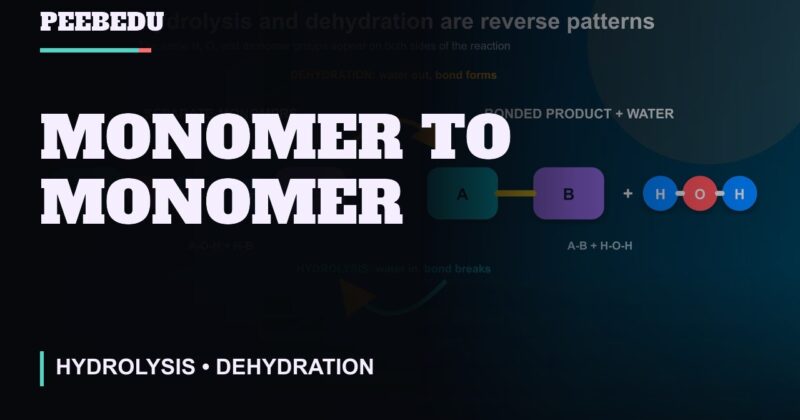
Hydrolysis breaks polymers apartHydrolysis cleaves the covalent bond between two monomers by adding water; the hydrogen ion is added to one monomer and the hydroxyl group to the other. Breaking food down this way releases subunits that the cell can then use to build its own molecules.
Conservation and uptake of matterOrganisms obtain atoms from food, water, air, and minerals. Metabolism rearranges those existing atoms into cellular molecules; cells do not create matter from nothing.
Four classes of macromoleculesCells build four major classes of macromolecules: carbohydrates, lipids, proteins, and nucleic acids. Each one is assembled from smaller subunits joined by covalent bonds, so a limited set of small pieces can be rearranged into an enormous variety of molecules.
CHNOPS elementsCarbon, hydrogen, nitrogen, oxygen, phosphorus, and sulfur are often summarized as CHNOPS or SPONCH. Together they account for most of the atoms in major biological macromolecules, although organisms also require other elements.
Carbon, hydrogen, and oxygen dominateCarbon, hydrogen, and oxygen are the most prevalent elements used to build biological molecules, and all three appear in carbohydrates, lipids, proteins, and nucleic acids. The other SPONCH elements are essential too, but they occur in smaller amounts and in more specific roles.
Nitrogen in proteins and nucleic acidsNitrogen is present in amino groups of amino acids and in the nitrogenous bases of DNA and RNA. It is therefore essential for building proteins and storing genetic information.
Sulfur-containing amino acidsSulfur occurs in the amino acids cysteine and methionine. Cysteine residues can form disulfide bonds that help stabilize the three-dimensional structures of some proteins.
Phosphorus in membranes and nucleic acidsPhosphorus is used to build phospholipids and nucleic acids. Phosphate is part of phospholipid heads and the repeating outer framework of DNA and RNA.
Phospholipids form membranesPhospholipids contain a phosphate group, and they group together to form the lipid bilayers found in plasma and cell membranes. That is one reason a cell's supply of phosphorus is tied directly to its ability to build and maintain membranes.
Same elements, different moleculesThe same small set of elements is combined in different amounts and arrangements to make every class of biological molecule. How the subunits are assembled determines a molecule's shape, and that shape determines the job it can do in the organism.
Metabolism rearranges atomsCatabolic pathways break molecules into smaller components, while anabolic pathways use atoms and energy to build new molecules. The atoms are conserved even though their bonds and arrangements change.