 SONG
Lyrical DNA
Make It Two
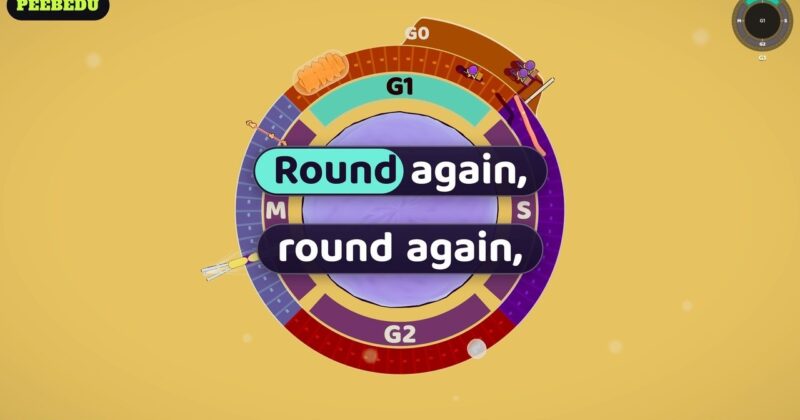
A song about mitosis. The lyrics follow one eukaryotic cell as its sister chromatids condense and the spindle forms, the chromosomes line up and are pulled apart, two new nuclei form and cytokinesis splits the cell into two genetically identical daughters, and they close on what that division is for: growth, repair and asexual reproduction. Select any highlighted line to see the biology behind it.
Trouble playing? Watch on YouTube
Interactive lyrics
Lines with a dotted underline and a + marker have an explanation. Select one and the science appears beside the lyrics. Everything else is ordinary lyric text.
Intro
One cell.
Whole code.
Watch it go.
Chorus
Make it two, make it two,
Make it two, make it two,
That is how the chromosome story goes.
For growth and repair, life knows what to do:
Verse 1
Every copied piece is in the proper groove.
Pre-chorus
Pack it in prophase,
Center on the line.
Pull the sisters clean apart,
Build the nuclei in time.
Chorus
Make it two, make it two,
One, one parent cell, two daughters coming through.
Make it two, make it two,
That is how the chromosome story goes.
For growth and repair, life knows what to do:
Verse 2
Then anaphase arrives and the fibers get to it.
So each forming daughter can receive the genome whole.
Break
Pack it, pack it.
Metaphase: line it.
Anaphase: pull it.
Telophase: wrap it.
Now there are two.
Bridge
Genetically identical and ready to survive.
Final Chorus
Make it two, make it two,
One, one, one parent cell, two daughters coming through.
Make it two, make it two,
Through every mitotic phase the sequence flows.
For growth, repair, reproduction too:
Outro
One cell.
Whole code, whole code.
Two cells.
Let's go.
Concepts covered
A process only eukaryotes runMitosis is how a eukaryotic cell divides its nucleus, and it alternates with interphase, the long stretch in which the cell grows and copies its DNA. Prokaryotes have no nucleus and no mitosis. A bacterium copies its single circular chromosome and splits in two by binary fission, with no spindle and no condensed chromosomes to line up. Mitosis is the more elaborate route that many long, linear chromosomes inside a nuclear envelope require.
Two daughters, same chromosome numberWhat doubles in cell division is the number of cells, not the number of chromosomes in each. A human body cell with 46 chromosomes copies its DNA during interphase, so for a while it holds twice the usual amount. Mitosis then splits those copies evenly, and each daughter cell ends with 46 chromosomes, the same as the parent. Daughter is simply the name for a cell produced by division; it has nothing to do with sex.
Why the order is fixedThe four words are the four phases: pack in prophase, line up in metaphase, pull apart in anaphase, close new nuclei in telophase. The order cannot change, because each step needs the one before it. Fibers cannot line up chromosomes that are still loose threads, sisters pulled before they are lined up can land at the same pole, and a nucleus closed too early traps both copies together. Each mistake leaves the daughters with the wrong chromosomes.
Seeing chromosomes under a microscopeBetween divisions the DNA is spread through the nucleus as thin chromatin, and a light microscope shows no separate chromosomes at all. In prophase each sister chromatid coils and folds on itself, and the chromosomes become short, thick rods that can be seen and counted. That is why chromosome counts and karyotypes are made from cells caught while dividing, and why a slide of a growing root tip lets you tell dividing cells from the rest.
Building the spindleThe spindle is built from microtubules, hollow fibers made of the protein tubulin, which grow out from the two centrosomes as those move apart. As the nuclear envelope breaks down, some fibers reach the chromosomes and attach at a protein structure on each sister chromatid near the centromere. Others overlap in the middle and push the poles apart. The result is a structure with two ends, ready to move every chromosome.
Metaphase: lined up and heldBy metaphase each chromosome's two sister chromatids are attached to fibers from opposite poles, one sister facing each way. Pulls from both sides balance, holding the chromosome on the cell's equator, the imaginary plane midway between the poles. This arrangement sets up the split: when the sisters separate, each one is already pointed at a different pole. The cell does not move on until every chromosome is attached this way.
Anaphase: sisters become chromosomesAnaphase begins when the proteins holding each pair of sister chromatids together are cut, all at once. From that moment each chromatid counts as its own chromosome, so a human cell briefly holds 92. The fibers attached to the chromosomes shorten and pull them toward the poles, while the overlapping fibers lengthen the cell. Because each pole receives one copy of every chromosome, both ends hold the same complete set.
Telophase: two new nucleiOnce the two sets of chromosomes reach the poles, the spindle has done its job and its microtubules come apart. A nuclear envelope forms again around each set, built from pieces of membrane left from the old envelope and the endoplasmic reticulum. The chromosomes then loosen back into chromatin, which lets genes be read again, and the cell now holds two complete nuclei that each carry one genome.
Cytokinesis: dividing the cytoplasmThe furrow forms around the cell's middle, where the chromosomes lined up in metaphase, so the cut always falls between the two new nuclei and each daughter gets one. It deepens until the membrane seals and the two cells separate. The cytoplasm, with its mitochondria, ribosomes and other contents, is shared roughly, not counted out exactly like the chromosomes; each daughter later makes more of what it needs.
Two processes, one divisionThe line names two processes because they are separate. Mitosis divides the nucleus, and cytokinesis divides the rest of the cell. They usually happen back to back, but they can come apart: some liver cells finish mitosis without dividing their cytoplasm and keep two nuclei in one cell. Cell division, in the full sense that yields two separate daughter cells, needs both.
What mitosis is forA human body grows from a single fertilized egg into trillions of cells by mitosis, and keeps replacing cells that wear out, such as skin and the lining of the gut, or healing a cut. In single-celled eukaryotes like yeast and amoebas, one mitotic division can be the whole act of reproduction, turning one organism into two. Many plants and some animals also reproduce asexually by mitosis, so the offspring are genetic copies of one parent.